
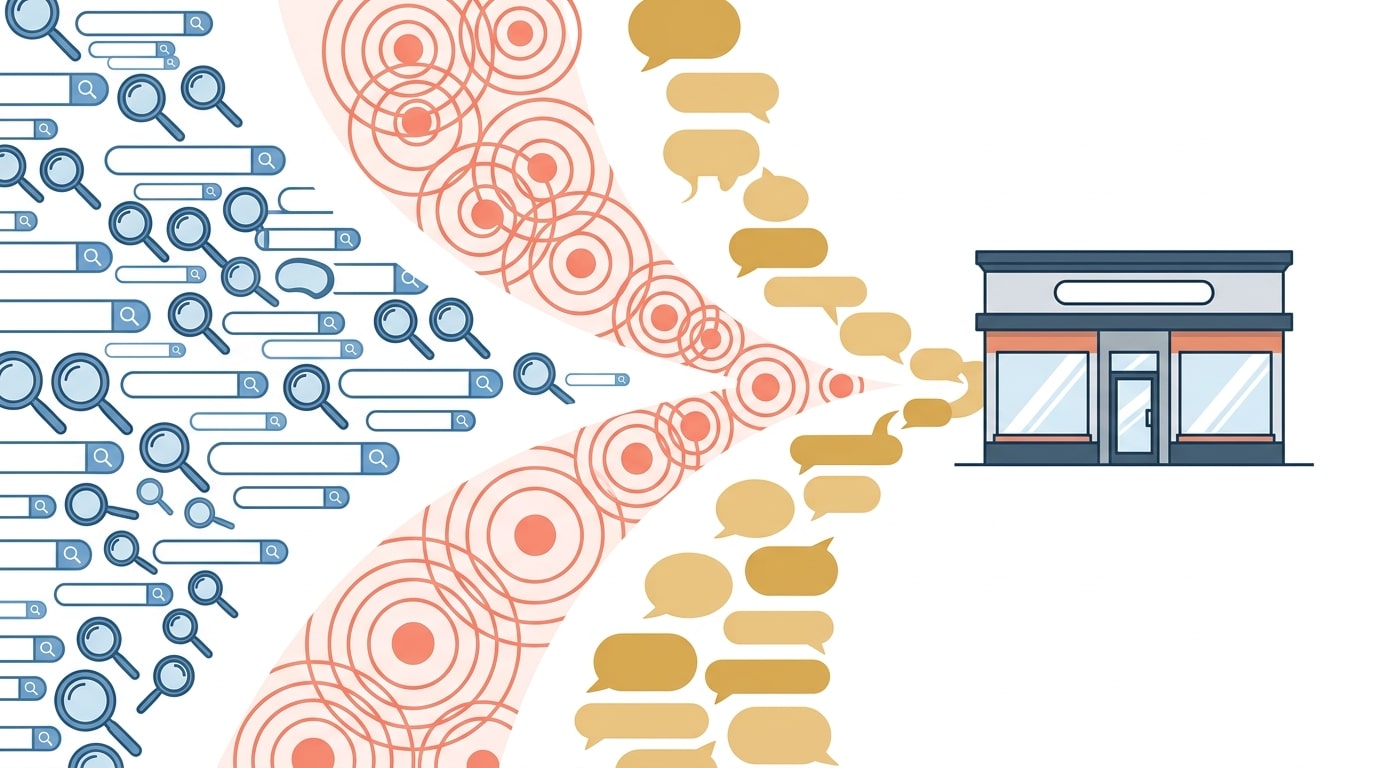
Every paid ad platform is really just answering one question — who should see this ad? — and each one answers it differently. Google Ads answers with a keyword. Facebook and Instagram answer with an audience profile. ChatGPT Ads answers with context — the actual conversation someone’s having in the moment.
Understanding that difference is the fastest way to stop wasting budget on the wrong channel, and to spot which one is worth testing while it’s still cheap.
How Each Platform Actually Decides Who Sees Your Ad
Google Ads: Keyword-Driven
Google Ads shows your ad because someone typed a specific word or phrase into a search bar, and you bid on that word. It’s precise — the person is telling you exactly what they want, right as they’re looking for it. That’s why Google Ads has stayed the go-to channel for high-intent purchases for over two decades: someone searching “emergency plumber near me” is already looking to hire, not just browsing.
Facebook & Instagram Ads: Audience-Driven
Facebook and Instagram don’t know what someone’s looking for in this exact moment — they know who that person is, built from years of likes, follows, and scroll behavior. That’s a fundamentally different kind of targeting, and it’s especially powerful for local businesses through geo-radius targeting: a coffee shop, bakery, or nail salon can set a 3-mile or 5-mile radius around their storefront and put ads in front of everyone who lives or works nearby — regardless of whether that person searched for anything at all. It’s built for foot traffic and visual discovery, not for catching someone at the exact moment of intent.
ChatGPT Ads: Context-Driven
ChatGPT Ads work off neither a keyword nor a stored profile — they work off the actual conversation someone’s having with the AI in that moment. If someone is talking through a decision — comparing options, working through a problem, asking for recommendations — the ad is matched to that real, live context. It’s the newest of the three mechanisms, and it’s the one advertisers understand the least right now, which is exactly why it’s worth paying attention to.
Comparison Table: At a Glance
| Google Ads | Facebook/Instagram Ads | ChatGPT Ads | |
|---|---|---|---|
| Targets based on | What someone typed (keyword) | Who someone is + where they are (audience + radius) | What someone’s working through (context) |
| Strong industries | Any business with real purchase intent — local, national, or international, service-based or e-commerce | Local, foot-traffic retail: coffee shops, bakeries, nail salons, restaurants, bars — anywhere a 3–5 mile radius drives walk-ins | Any industry — local, national, international, service-based, or e-commerce |
| Weak fit for | Low search-volume niche products | Cold e-commerce (fine as retargeting, weak for cold acquisition); highly considered B2B sales | Emergency/urgent services (still better served by search intent in the moment) |
| Maturity in 2026 | Fully mature, expensive | Mature, CPMs climbing | Ground floor — cheap, low competit |
Which Industries Fit Each Platform
Google Ads
Anywhere there’s real purchase intent — someone actively searching to solve a problem or make a decision. That covers local service businesses (plumbers, roofers, dentists, attorneys), national and international service providers, and e-commerce. If people are already typing in what they want, Google Ads puts you in front of them.
Facebook & Instagram Ads
Local, foot-traffic-dependent retail is the strongest fit: coffee shops, bakeries, nail salons, restaurants, and bars all benefit from radius targeting that puts the ad in front of everyone within a few miles of the door. Straight e-commerce is a weaker fit here unless it’s retargeting — showing ads to people who already visited your site or added something to a cart. Cold e-commerce acquisition and complex B2B sales tend to underperform on these platforms, since there’s no purchase intent driving the click.
ChatGPT Ads
This is the one platform without a narrow lane. Because it’s matching ads to context rather than a keyword or a demographic bucket, it works across local, national, and international businesses, service-based and e-commerce alike. The one soft spot is true emergencies — someone with a burst pipe is still going to search Google, not have a conversation about it first. Everything else is fair game.
The Platform Curve Always Repeats
Google Ads launched as AdWords in October 2000. Facebook Ads opened up in the mid-2000s. Both started cheap, with almost no competition, and both got more expensive every year as more advertisers piled in. That’s not a coincidence — it’s the pattern every ad platform follows. Cheap and wide open at birth. Expensive and crowded once everyone catches on.
ChatGPT Ads is at day one of that same curve right now. Self-serve access only opened in May 2026. That won’t last — it never does.
Which One Should You Actually Use?
For most businesses, the honest answer is more than one. A local bakery might run Facebook for foot traffic and Google for people actively searching “bakery near me.” A national service company might run Google for intent-driven leads and start testing ChatGPT Ads to build early account history before the platform matures and prices climb.
If you’re weighing whether ChatGPT Ads makes sense for your business specifically, that’s exactly what we walk through on a strategy call — see our ChatGPT Ads services here.